Images and Shadows by Iris Origo
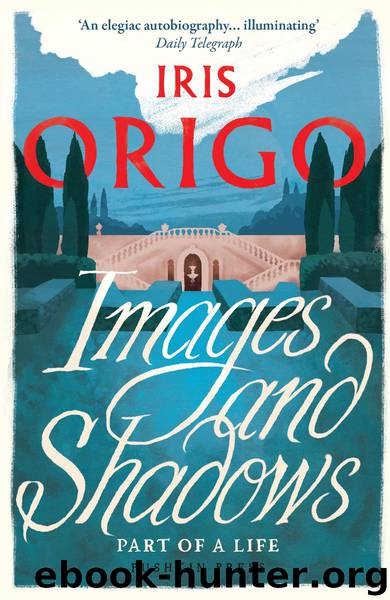
Author:Iris Origo [Iris Origo]
Language: eng
Format: epub
ISBN: 9781782272793
Publisher: Pushkin Press
Published: 2017-09-17T04:00:00+00:00
6
Reading and Learning
… As pines
keep the shape of the wind
even when the wind has fled and is no longer there
so words
guard the shape of man.
GEORGE SEFERIS, TRANS. WALTER KAISER
What do we mean by being alone? Rumer Godden is of the opinion that, from the day that a child has learned to read, he will never be so again. “When you learn to read,” she said to her own daughter, “you will be born again, and it is a pity to be born again so young. As soon as you learn to read, you will not see anything again quite as it is. It will all the time be altered by what you have read, and you will never be quite alone again.”
I think that there is something in this, in the sense that we do not look at a landscape again in quite the same way after we have once seen a great painter’s rendering of it: the blue hills of the Veneto come to resemble the background to Bellini’s Madonnas, the crete senesi turn into the landscapes of Sassetta or Sodoma. But I do not agree that it is an argument against teaching a child how to read, or if it is, then we must also exclude all telling of stories. ‘The Three Bears’ and ‘Little Black Sambo’, ‘The Constant Tin Soldier’ and ‘The Dog with Eyes as Big as Saucers’, have already become our companions long before we can read ourselves; they have already peopled our world. All that is achieved by the final act of reading to itself is to enable a child to summon up that other world at its own will. ‘My whole being’, wrote Coleridge of his boyhood, ‘was, with eyes closed to every object of present sense, to crumple myself up in a sunny corner and read, read, read,—fancying myself into Robinson Crusoe’s island, finding it a mountain of plum-cake and eating a room for myself and then eating it into the shapes of tables and chairs.’
It is the extreme concreteness of a child’s imagination which enables him, not only to take from each book exactly what he requires—people, or genii, or tables and chairs—but literally to furnish his world with them. I can remember no time when I did not do this, nor can I remember when I learned to read. I only know that it must have been fairly soon, since a letter of my mother’s, when I was just four, speaks of my finding it easier to read in Italian than in English, and by six I could also read French. German I spoke from the age of four, but only learned to read it later on. This early teaching did not, unfortunately, make a good linguist of me, but it did leave me with the knowledge that any language will do for telling a story. Struwelpeter and Sophia were as familiar figures of the nursery as Humpty Dumpty, Pinocchio as Alice. It was only a little later on that
Download
This site does not store any files on its server. We only index and link to content provided by other sites. Please contact the content providers to delete copyright contents if any and email us, we'll remove relevant links or contents immediately.
We're Going to Need More Wine by Gabrielle Union(19046)
Pimp by Iceberg Slim(14506)
Bombshells: Glamour Girls of a Lifetime by Sullivan Steve(14073)
The Radium Girls by Kate Moore(12028)
Becoming by Michelle Obama(10026)
Educated by Tara Westover(8053)
The Girl Without a Voice by Casey Watson(7888)
Wiseguy by Nicholas Pileggi(5782)
The Wind in My Hair by Masih Alinejad(5095)
Hitman by Howie Carr(5094)
The Rules Do Not Apply by Ariel Levy(4967)
Hunger by Roxane Gay(4927)
On the Front Line with the Women Who Fight Back by Stacey Dooley(4872)
Year of Yes by Shonda Rhimes(4757)
The Borden Murders by Sarah Miller(4325)
Papillon (English) by Henri Charrière(4274)
Joan of Arc by Mary Gordon(4109)
American Kingpin by Nick Bilton(3886)
Patti Smith by Just Kids(3777)
